





- A watch is traditionally worn on the non dominant wrist, mainly to avoid scratching it while writing or working.
- A rigid steel bangle and a watch rarely get along on the same wrist: they knock together, scratch each other, and both end up worse for it.
- Mixing metals works perfectly well today, as long as it is a deliberate choice and not a random pairing.
You often hear that you have to choose between wearing a watch and wearing a bracelet, as if the two could not share the same arm. That is not true. There are, however, three or four concrete rules worth knowing before combining them, or you risk scratching your watch or ending up with a cluttered, noisy wrist in a meeting.
À découvrir


Whether you wear a solid steel men's bangle bracelet or something softer, the question of which wrist and how to mix materials comes up every time you add a piece next to your watch.
Which wrist should the watch go on?
The convention comes from a practical detail more than a style rule: the watch is worn on the non dominant wrist to limit knocks and scratches while writing, typing, or working with the dominant hand. Since roughly 9 out of 10 people are right handed, the watch ends up on the left wrist most of the time. Left handed people often do the opposite, and that is just as valid. There is no etiquette rule that requires it, only a habit that protects the piece.
Bracelet on the same wrist as the watch, or the other one?
The answer mostly depends on what the bracelet is made to do:
- A thin steel chain bracelet flexes around the wrist and does not weigh on the case, so it pairs fine with the watch on the same wrist.
- A leather bracelet, braided or flat, also works fine next to the watch if its color matches the watch strap (brown with brown, black with black).
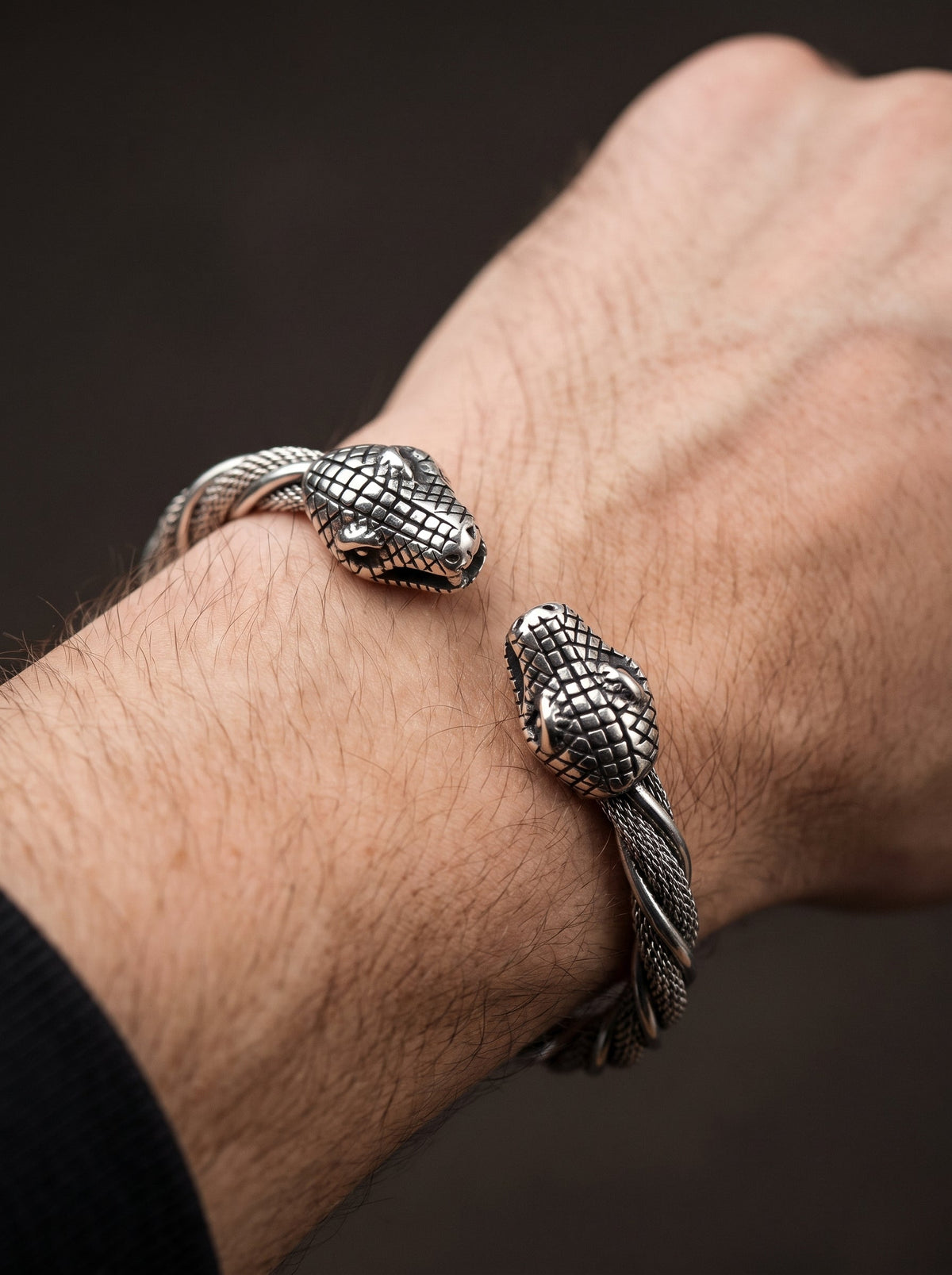
- A rigid steel bangle, like most engraved viking styles, is better off on the other wrist. Its rigidity makes it knock against the case every time the arm moves.
Does a rigid bangle really damage the watch?
In practice, the dial itself (protected by glass or sapphire) is rarely at risk. What actually takes the hit is the case, and especially the watch strap: a brushed steel case marks more easily than a polished one, and a leather or resin strap gets scratched from repeated contact with a metal bangle. The simplest fix is to keep the two on separate wrists, or to pick a slightly open, adjustable bangle rather than a closed ring that spins and rubs constantly.
Mixing metals: the real consensus
Randomly mixing silver toned and gold toned steel is the classic trap. The rule that works almost every time: match the color of the steel bracelet to the watch case or strap. Silver toned case with silver toned steel, black or DLC case with black steel. A deliberate mix (a gold toned bracelet with a silver toned watch, for example) also works, but only as a clear choice, not an afterthought. For more on this, our guide to matching men's jewelry covers the combinations that work day to day.
A few combinations that work
| Look you want | Bracelet | Recommended wrist |
|---|---|---|
| Rugged, viking | Viking steel bangle | Opposite wrist from the watch |
| Minimalist, office | Thin steel chain | Same wrist as the watch |
| Casual, leather | Braided leather bracelet | Same wrist, matching color |
| Relaxed | Beaded bracelet | Opposite wrist if the watch is slim |
To explore the full range of materials and styles, the complete men's bracelet guide is the best place to start before picking a piece to pair with your watch, and the men's bracelet collection lets you compare styles side by side.

Frequently asked questions
Do the watch strap and the bracelet have to match exactly?
No, but it is the safest way to get a result that looks intentional. Same metal tone or leather tone, and the whole thing reads as coherent without effort. A deliberate contrast (black steel with a silver toned case) also works, as long as it looks chosen rather than accidental.
Can you wear two steel bracelets at the same time as a watch?
Yes, as long as they stay on the wrist opposite the watch or are thin and flexible. Beyond two extra pieces on top of the watch, the wrist quickly gets cluttered and noisy. It is better to vary the thickness than to stack identical pieces.
Does wearing a bracelet really damage a watch over time?
A flexible bracelet (thin chain, leather) barely causes any wear. A rigid bracelet worn on the same wrist, on the other hand, marks the case and the watch strap through repeated friction. The simple fix: rigid on one side, watch on the other.
Stag Bijoux, stainless steel jewelry for men, online.
Leave a comment
This site is protected by hCaptcha and the hCaptcha Privacy Policy and Terms of Service apply.